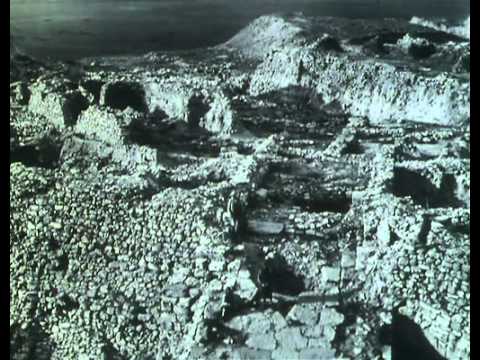
In this 1985 BBC-documentary Michael Wood examines the historical and archeological evidence of the legendary Trojan War. Wood travels from Berlin to the Mediterranean and explores how much truth there is to be found in the Iliad, the account of the Trojan War written by Homer around 700 B.C. As he matches the purely historical and archeological evidence with the tale told by Homer, Wood brings back to life the struggle of early archeologists like Heinrich Schliemann. Schliemann was the first to take the Iliad at face value and regard it as a true story, connecting it with the finds. His intellectual heirs, like Arthur Evans continued the investigation to the ancient Greeks.
Wood shows how the perception of the Trojan War has changed over the years. Moreover, he meticulously researches every piece of historical evidence and convincingly fits it into the Iliad. But he also vividly retells one of the greatest stories of mankind. He takes us back to a world of political intrigue, ancient heroes and an epic war.
Episode 1: The Age of the Heroes
In this first episode, Michael Wood examines how the story of Homer was transformed by Heinrich Schliemann, the first person to regard the story as an eye-acount instead of a myth.
Episode 2: Legend under siege
How did the pioneer archaeologists examined their findings? How did they reveal the truth about Troy? Michael Wood explains it.
Episode 3: The singer of tales
The legendary bard Homer sang his song of Troy and immortalized the war. But how much truth is to be found in its words?
Episode 4: The Women of Troy
Helen of Troy was the main reason to fought the war in the first place, at least thats what Homer tells us. Wood examines the position of Helen and explains what the real reason for war could have been.
Episode 5: The Empire of the Hittites
The Hittite empire was known for its administration. Wood examines how the Trojan War was described by Agamemnon’s neighbours.
In Search Of The Trojan War Ep6. The Fall of Troy
The end of Troy marked the decline of all Greek empires across the Aegean. Wood show how this is to be read from the archeological evidence.